

World's Largest Cities in 1926 vs 2026
In a hundred years, the world's largest cities have changed dramatically.

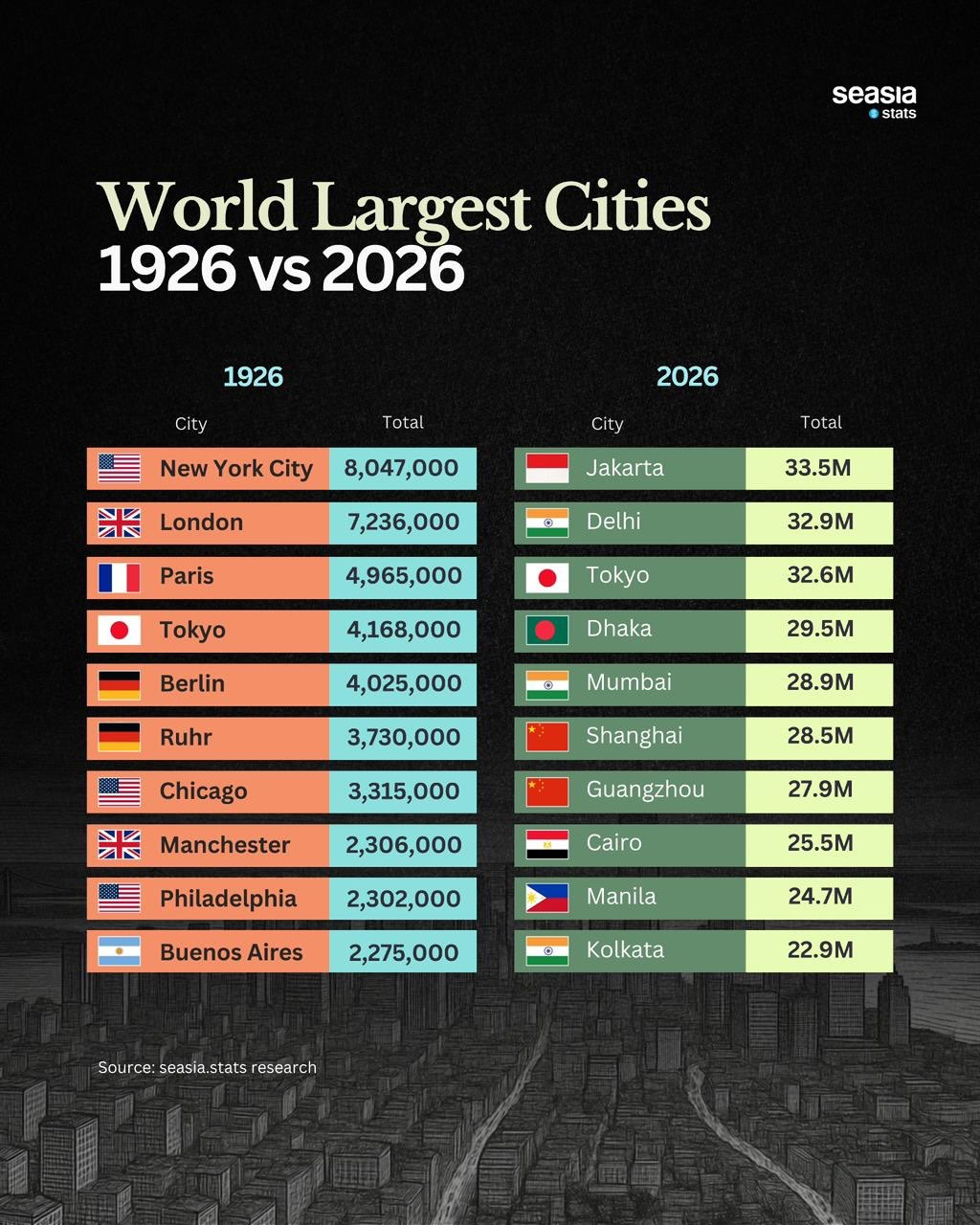
A century separates the world’s largest cities of 1926 and 2026, yet both lists reveal how urban life reflects the balance of economic power, migration, industry, and culture. In 1926, the leading cities were concentrated in Europe and North America, the industrial heartlands of the early twentieth century.
By 2026, the urban center of gravity has shifted decisively toward Asia and the Global South, where rapid population growth and economic expansion have created enormous metropolitan regions.
In 1926, New York City was the world’s largest city with 8,047,000 inhabitants. Its towering skyline, crowded harbor, and immigrant neighborhoods symbolized modern urban ambition.
London followed with 7,236,000 residents, still benefiting from the influence of the British Empire. Paris, with 4,965,000 people, remained a global center of art, fashion, and intellectual life. Tokyo already ranked fourth with 4,168,000 inhabitants, demonstrating Japan’s emergence as an industrial power.
Other major cities included Berlin, the industrial Ruhr region in Germany, Chicago, Manchester, Philadelphia, and Buenos Aires. These cities were dominated by factories, railroads, and expanding working-class populations.
Their inhabitants often lived in crowded neighborhoods, but they were also connected to new opportunities in manufacturing, trade, and entertainment.
By 2026, the urban map of the world looks dramatically different. Jakarta leads with 33.5 million inhabitants, reflecting Southeast Asia’s rapid urbanization. New Delhi and Tokyo follow closely with more than 32 million residents each.
Cities such as Dhaka, Mumbai, Shanghai, and Guangzhou have expanded into vast megacities powered by manufacturing, finance, and technology. Cairo, Manila, and Kolkata complete the list.
The inhabitants of these modern megacities experience both opportunity and challenge. Advanced transportation, digital communication, and global commerce connect millions of people every day.
At the same time, overcrowding, pollution, housing shortages, and climate pressures test the resilience of urban societies. Comparing 1926 and 2026 shows not only how cities have grown, but also how humanity itself has become increasingly urban, interconnected, and dependent on the success of its great metropolitan centers.